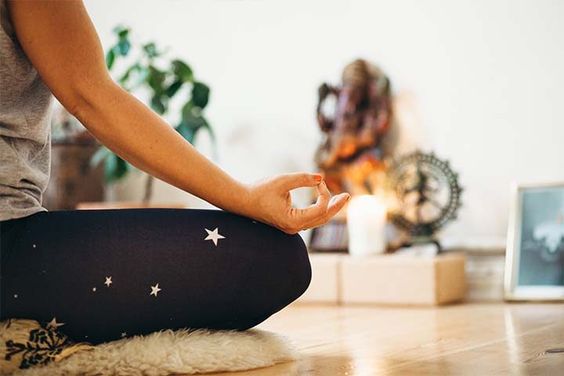
During yoga or meditation, you may have noticed that your fingers and hands take on intriguing shapes or forms. similar to clasping both hands together in meditation or placing your hands in the Surya Namaskar prayer position?
These hand and finger positions are considered to be mudras that open chakras in our bodies, which are sacred gestures. They serve a function and have value, just like other aspects of yoga.
Understanding what chakra meditation is can help practitioners use focused breathing, meditation, and traditional mudras to cultivate greater awareness of the body’s energy centers.
This blog will explain what mudras are, how important they are in meditation and yoga, and some of the top mudras for daily yoga practice and chakra meditation balancing.
What Are Chakras?
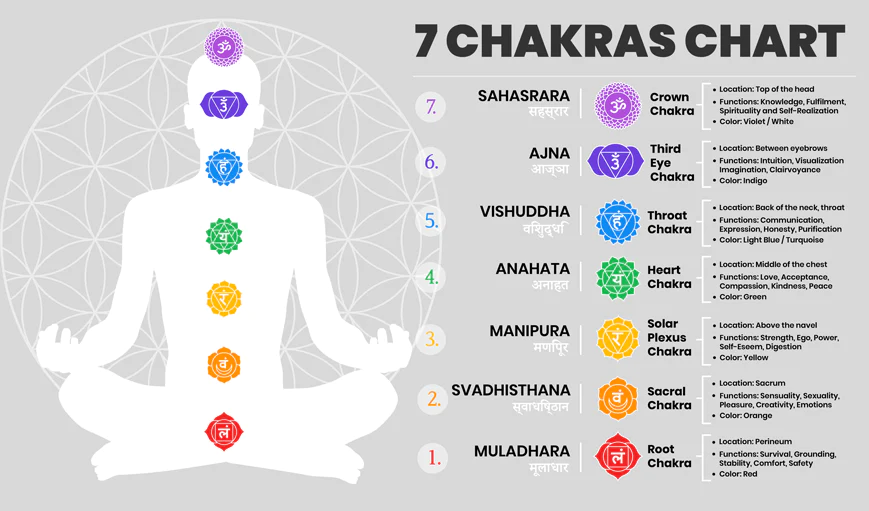
The energy regions of the body are known as chakras. They are found in the astral body, running from the base of the spine up to the crown of the head. The energy body that resides inside our physical body is called the astral body.
There is an astral body part that corresponds to each physical body part. It is impossible to see or touch the astral body. We are unable to view the chakras for the same reason.
What are Chakra Fingers?
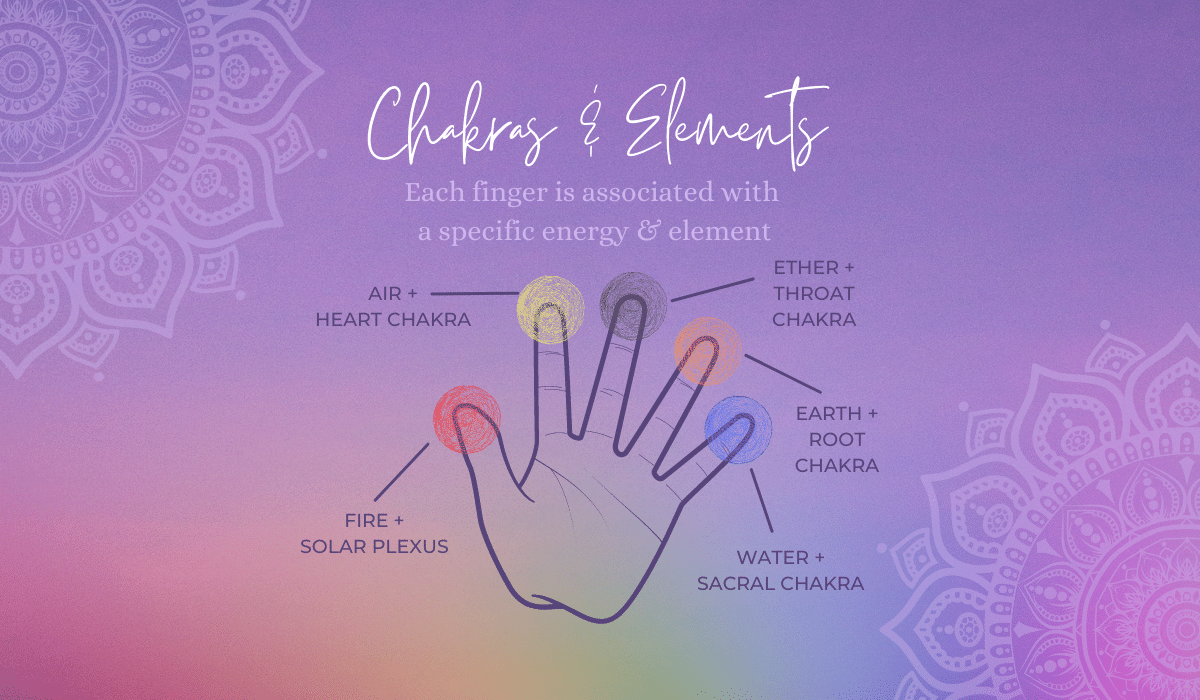
Chakra fingers refer to the use of specific finger positions and hand mudras during chakra-focused meditation and yoga. While the five fingers are traditionally associated with the five elements—Fire, Air, Space, Earth, and Water—chakra practices use different mudras to support meditation on particular energy centers.
This means that finger-element associations and chakra-mudra associations are related but are not the same mapping. For example, the ring finger is associated with the Earth element, while the Root Chakra is also traditionally associated with Earth.
To make these connections easier to understand, the 7-chakra mudra chart below pairs each of the seven primary chakras with a commonly used mudra and its seed mantra. The chart provides a simple guide for incorporating hand positions into chakra meditation, from the Root Chakra (Muladhara) through the Crown Chakra (Sahasrara).
What Is Mudra Chikitsa?
Mudra Chikitsa is a therapeutic system within yoga that uses hand gestures to regulate energy flow in the body. Each finger represents an element, and by combining fingers in specific ways, we influence chakras and bodily functions.
Why Chakra Mudras Are Ideal for Beginners
- No physical strain or intense movement
- Can be practiced anywhere
- Suitable for all age groups
- Helpful for people with medical conditions
- Easy to learn and remember
This makes chakra mudras for beginners an excellent starting point for holistic wellness.
Important Guidelines for Chakra Mudras for Beginners
Before practicing chakra mudras, beginners should keep a few key points in mind:
- Practice only for the recommended duration
- Do not exceed the suggested time
- Maintain relaxed breathing
- Practice consistently, not excessively
- Stop if you feel discomfort
Mudras are subtle practices—more is not always better.
The Origins of Mudras & Hand Healing:
Meditation has long been recognized as a powerful practice for cultivating inner peace, focus, and spiritual growth. While most people associate meditation with breathing techniques, mindfulness, or mantra chanting, a lesser-known but equally potent practice involves the use of Mudras & Hand Healing—symbolic hand gestures that channel and redirect energy within the body. Rooted in ancient yogic and Ayurvedic traditions, mudras are believed to influence physical, emotional, and spiritual well-being.
Mudras & Hand Healing have their roots in ancient Indian spiritual practices. They are widely mentioned in texts such as the Vedas, Upanishads, and various yogic scriptures. The word mudra is derived from Sanskrit, meaning “seal,” “gesture,” or “symbol.” In the context of meditation, mudras act as seals that direct energy flow, creating a bridge between the physical and subtle bodies.
In addition to yoga, Mudras & Hand Healing are integral to Buddhist meditation, classical Indian dance forms, and even Tantric rituals. Over centuries, they evolved into therapeutic tools, with Ayurveda recognizing their role in balancing the doshas (Vata, Pitta, Kapha) and improving overall health.
Hand Mudras for Meditation: Positions and Timing
Hand mudras are traditional gestures used during meditation, yoga, and chanting to give the mind a physical point of focus. In chakra meditation, practitioners commonly pair a mudra with the chakra’s location, color, visualization, and seed mantra. The current chakra system in this guide already identifies the seven primary chakras and their associated mantras, including Lam for the Root Chakra, Vam for the Sacral Chakra, Ram for the Solar Plexus, Yam for the Heart, Ham for the Throat, Om for the Third Eye, and Aum for the Crown.
For meditation, sit comfortably with your spine relaxed and upright. Rest your hands on your thighs or knees and form the chosen mudra without pressing the fingers together forcefully. Keep the hands relaxed and breathe slowly and naturally.
A simple sequence is to choose one chakra, form its corresponding mudra, focus on the chakra area, and repeat its seed mantra. For example, you might use Prithvi Mudra with the Root Chakra while silently repeating Lam. For the Sacral Chakra, Shakti Mudra can be paired with Vam.
Mudras do not need to be complicated. The goal is consistent, comfortable practice rather than creating tension in the hands. Beginners can start with one chakra at a time and gradually incorporate a complete seven-chakra meditation.
What Are Mudras and Why Are They So Powerful?
Mudras are symbolic gestures involving the fingers, hands, or even the whole body. While many people think mudras are limited to hand gestures, they can also involve posture, breath, and body alignment—making them almost like half-asanas.
Because mudras are simple and portable, they can be practiced:
- During meditation
- While sitting, walking, or resting
- Even during daily activities
This accessibility makes understanding the connection between chakras and fingers especially valuable in modern, fast-paced lifestyles.
Understanding the Connection Between Fingers and Chakras:
Each finger corresponds to a specific chakra and element. By activating or pressing certain fingers, we stimulate nerve endings and energy channels that influence the related chakra.
This energetic mapping allows practitioners to:
- Balance chakras naturally
- Release emotional blockages
- Improve mental clarity and grounding
- Support physical and emotional healing
Chakra Cleansing Mudras and Mantras
Chakra cleansing meditation traditionally combines hand mudras, focused breathing, visualization, and seed mantras. The practice is intended to help practitioners focus their awareness on each energy center rather than serving as a substitute for medical treatment. Each chakra in the traditional seven-chakra system is associated with a particular bija, or seed, mantra.
1. Root Chakra – Prithvi Mudra + Lam: Touch the tip of the thumb to the ring finger while keeping the other fingers comfortably extended. Focus on grounding, stability, and the red color traditionally associated with Muladhara.
2. Sacral Chakra – Shakti Mudra + Vam: Bring the hands together in the traditional Shakti Mudra position and focus attention on the lower abdomen. Repeat Vam while visualizing orange.
3. Solar Plexus Chakra – Rudra Mudra + Ram: Touch the thumb, index finger, and ring finger together. Focus on the area around the navel and repeat Ram.
4. Heart Chakra – Padma Mudra + Yam: Form Lotus Mudra in front of the heart and repeat Yam, focusing on compassion and openness.
5. Throat Chakra – Akash Mudra + Ham: Touch the thumb to the middle finger and repeat Ham while bringing awareness to the throat.
6. Third Eye Chakra – Hakini Mudra + Om: Bring the fingertips of both hands together and focus gently between the eyebrows while repeating Om.
7. Crown Chakra – Gyan Mudra + Aum: Touch the thumb and index finger together and rest the hands on the knees. Focus on the crown of the head while repeating Aum.
These pairings provide a simple framework for moving through the chakras while keeping the meditation structured and easy to follow.
Best Mudras for Stress Relief and Chakra Balancing
Below are some of the most effective and widely practiced mudras for stress relief.
1. Chin Mudra – The Mudra of Grounding and Calm
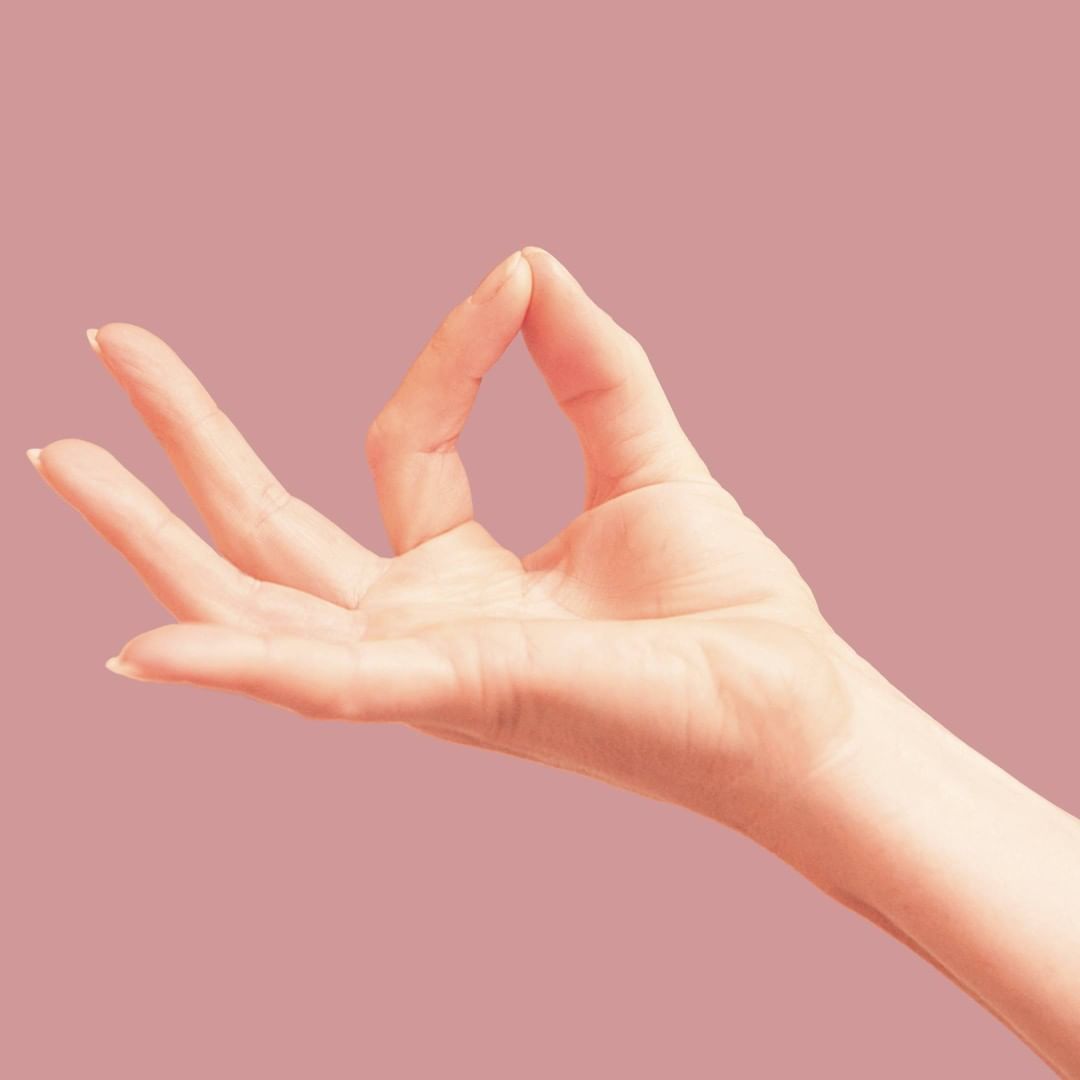
Chin Mudra is one of the most commonly used mudras for stress relief during meditation and yoga practice. It connects the individual with the earth element, creating a strong sense of grounding and emotional security.
Benefits of Chin Mudra
- Reduces stress and anxiety
- Lowers blood pressure
- Improves focus and memory
- Removes negative thought patterns
- Enhances emotional stability
Chakra Activated
- Root Chakra
How to Practice Chin Mudra
- Sit comfortably in a meditative posture
- Touch the tip of the thumb to the tip of the index finger
- Keep the other three fingers extended and relaxed
- Rest your hands on your knees with palms facing upward
This mudra creates deep calmness, removes dullness, and promotes a light, joyful state of mind.
2. Prana Mudra – The Mudra of Life Force Energy
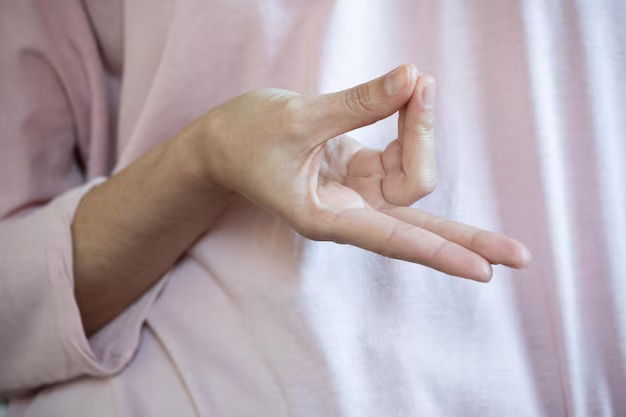
Prana Mudra is often called the mother of all mudras. It revitalizes the body and mind by enhancing the flow of prana, making it one of the most powerful mudras for stress relief.
Benefits of Prana Mudra
- Removes fatigue and mental exhaustion
- Reduces anxiety and emotional heaviness
- Increases vitality and positivity
- Clears energetic blockages
Chakras Activated
- Root Chakra
- Sacral Chakra
How to Practice Prana Mudra
- Touch the tips of the thumb, ring finger, and little finger
- Keep the index and middle fingers straight
- Close your eyes and breathe slowly
- Practice with gentle awareness or Ujjayi breathing
This mudra brings a deep sense of calm and prevents dullness caused by chronic stress.
3. Gyan Mudra – The Mudra of Mental Clarity

Stress often arises from overthinking and mental clutter. Gyan Mudra is one of the most effective mudras for stress relief when stress is rooted in mental overload.
Benefits of Gyan Mudra
- Calms the mind
- Improves concentration
- Reduces mental tension
- Enhances mindfulness
Chakras Activated
- Heart Chakra
- Crown Chakra
How to Practice Gyan Mudra
- Touch the index finger to the thumb
- Keep the other fingers relaxed
- Practice during meditation or mindful breathing
4. Apana Mudra – The Mudra of Emotional Detox
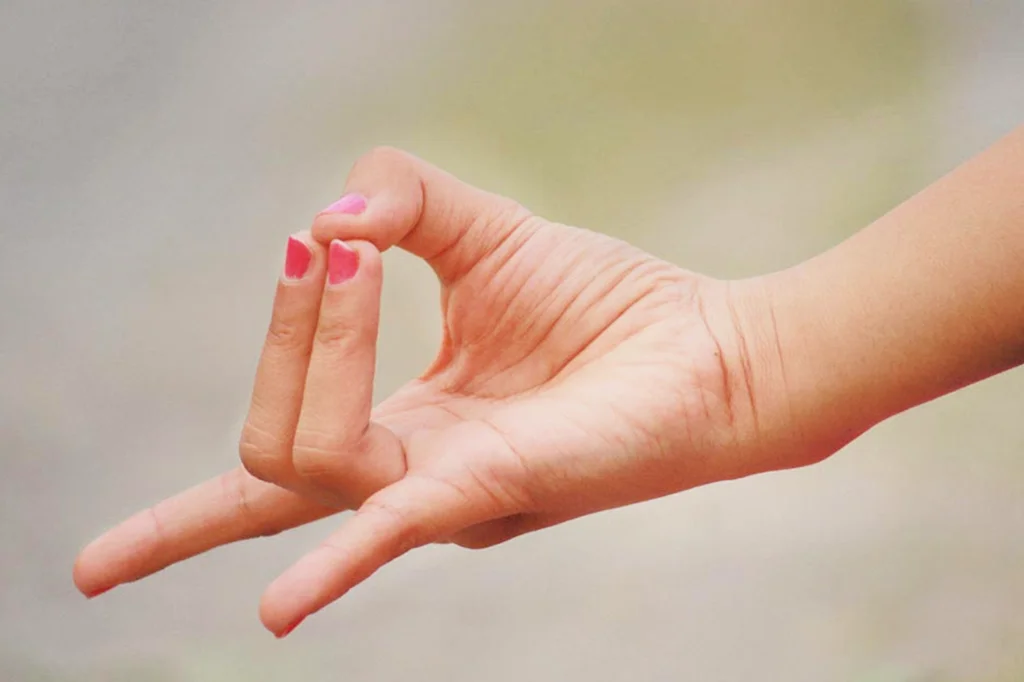
Apana Mudra helps release emotional toxins that accumulate due to prolonged stress and anxiety.
Benefits of Apana Mudra
- Removes emotional heaviness
- Supports detoxification
- Reduces restlessness
- Promotes inner stability
Chakra Activated
- Solar Plexus Chakra
How Long to Hold Each Mudra
There is no single required duration for every chakra mudra. Traditional practices vary, and comfort should take priority over forcing the hands to remain in one position. For beginners, 5–10 minutes per mudra is a practical starting point. Those who are comfortable with the practice can gradually extend the duration to 15–20 minutes.
If you want to practice all seven chakras in one meditation, spending about 3–5 minutes on each mudra creates a manageable 20–35-minute session. Alternatively, you can select one chakra and remain with its mudra for 10–15 minutes.
A simple schedule is:
- Root – Prithvi Mudra: 5–10 minutes
- Sacral – Shakti Mudra: 5–10 minutes
- Solar Plexus – Rudra Mudra: 5–10 minutes
- Heart – Padma Mudra: 5–10 minutes
- Throat – Akash Mudra: 5–10 minutes
- Third Eye – Hakini Mudra: 5–10 minutes
- Crown – Gyan Mudra: 5–10 minutes
While holding each mudra, combine relaxed breathing with the chakra’s seed mantra. If your fingers become uncomfortable, release the position and rest your hands. Consistency is generally more useful than forcing a long session, so a short daily practice can be a better starting point than an occasional extended meditation.
Role of Chakras in Energy Balance
Chakras are energy centers aligned along the spine. When chakras are blocked or imbalanced, energy flow is disrupted, which may affect physical health and emotional stability.
Finger mudras and chakra activation work together by:
- Clearing energetic blockages
- Improving pranic circulation
- Enhancing mind-body awareness
How Many Chakra Fingers Are There In The Body?
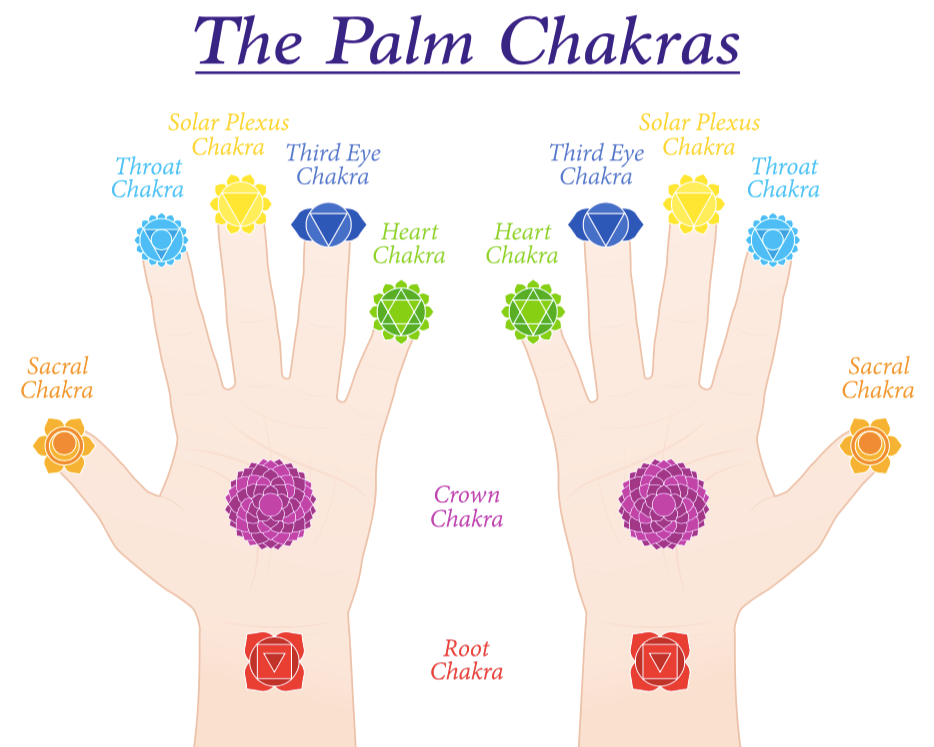
The majority of the time, we hear the phrase “seven chakras,” yet the human body contains an endless number of chakras. Each of the seven chakras has a particular vibration, color, symbol, and sound attached to it.
Understanding the meaning behind meditation symbols can add depth to chakra meditation by helping practitioners connect the visual forms, colors, and traditional associations of each chakra with their meditation practice.
Understanding kundalini meditation and the chakras can provide additional context for how traditional yoga practices view the chakras as centers of energy along the body’s subtle pathway.
Your mental, physical, and emotional health may manifest differently based on whether these energy points are open or blocked. As they manifest in the body, the seven primary chakras are:
- Muladhara Chakra Means – Root Chakra or Prithvi Mudra or Gyan Mudra
- Svadhishthana Chakra Means – Sacral Chakra Mudra or Shakti Mudra
- Manipura Chakra Means – Solar Plexus Chakra Mudra or Rudra Mudra
- Anahata Chakra Means – Heart Chakra Mudra or Padma Mudra
- Vishuddha Chakra Means – Throat Chakra Mudra
- Ajna Chakra Means – Third Eye Chakra Mudra
- Sahastrara Chakra Means – Crown Chakra Mudra
1. Muladhara Chakra Or Root Chakra Mudras:
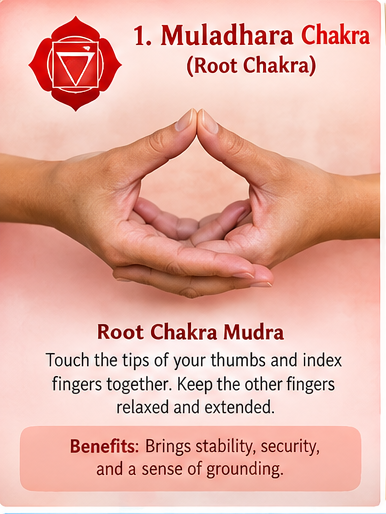
The Root Chakra Mudra or Muladhara Mudra has a lotus flower with 4-petals, a square, as well as a triangle facing downward. Each element represents the 4 characteristics of the human mind, connecting to construct the birth of consciousness in human beings.
Element: The Earth
Color: Red
Location: This Chakra, also known as Muladhara Chakra, is found at the bottom of your spine, between your genitals and your anus. It’s represented by the emotions of stability, survival, self-sufficiency, and ambition.
Balanced Signs: Yet, as soon as your Root Chakra is balanced, these are substituted by more positive emotions, and you feel confident, stable, balanced, independent, energetic, and also strong.
Blocked Signs: As soon as the Root Chakra is imbalanced, an individual starts feeling ungrounded, unstable, fearful, lacking ambition, insecure, lacking purpose, and even frustration.
Yoga Poses: Tadasana (Mountain Pose) and Vrkshasana (Tree Pose)
Beej Mantra: The beej mantra (seed mantra) of Root Chakra is ‘Lam’.
2. Svadhishthana Chakra Or Sacral Chakra:
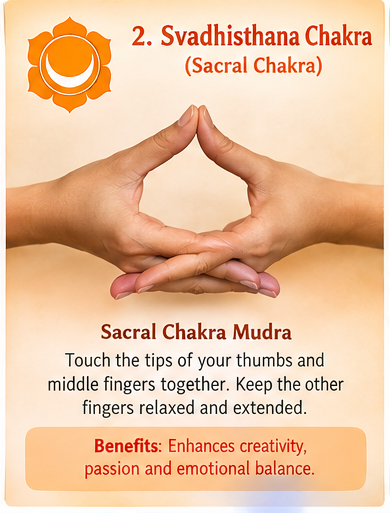
The Svadhishthana Chakra, also known as the Sacral Chakra, is represented by a crescent moon, six petals of a lotus flower, and several circles. The six petals depict the six negative parts of our nature that we must get through to awaken this chakra, while the circles as well as the crescent moon symbolize the cycle of life, rebirth, and death.
Element: Water
Colors: Orange
Location: This Chakra is found in the lower abdomen, around 4 fingers below your navel. Its features include the fundamental need for creativity, sexuality, and also self-worth.
Balanced Signs: When balanced, this makes you feel happier, more vibrant, positive, compassionate, intuitive, and satisfied.
Blocked Signs: A blocked sacral chakra makes you feel irritable and emotionally explosive, feel manipulative, feel a lack of creativity and energy, or be plagued with sexual ideas.
Yoga Poses: Kakasana (Crow Pose) or Trikonasana (Triangle Pose).
Beej Mantra: This Chakra’s beej (seed mantra ) is ‘Vam’.
3. Manipura Chakra Or Solar Plexus Chakra:
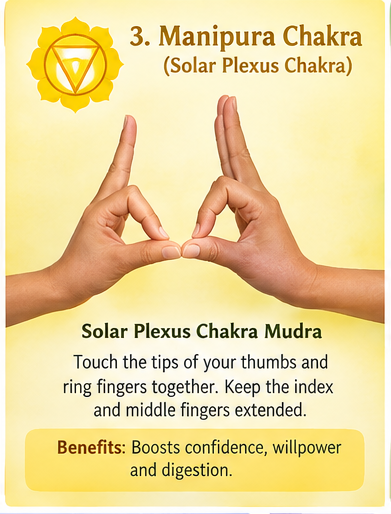
The symbol for the solar plexus chakra is a downward-pointing triangle enclosed in a lotus flower with ten petals. The triangle represents our inner power, and the triangle’s Agni tattva, or fire of spiritual energy, represents the ten petals, which stand for the ten negative character qualities we must overcome.
Elements: Fire
Colors: Yellow
Location: Between your navel and your rib cage’s base, near the solar plexus, is where the Manipura Chakra is situated. Emotions like anger, ego, and aggressiveness are its defining characteristics.
Balanced Signs: We experience an increase in energy, self-assurance, productivity, and attention when this chakra is balanced.
Blocked Signs: Physical symptoms of a solar plexus chakra imbalance include diabetes, liver issues, and digestive issues. A person may experience emotional difficulties such as depression, low self-esteem, rage, and perfectionism.
Yoga Poses: Paschimottanasana (Classical Forward Bend), Bhujangasana (Classical Cobra Pose), and Dhanurasana (Bow Pose).
Beej Mantra: This Chakra’s beej (seed mantra) is ‘Ram’.
4. Anahata Chakra Or Heart Chakra:
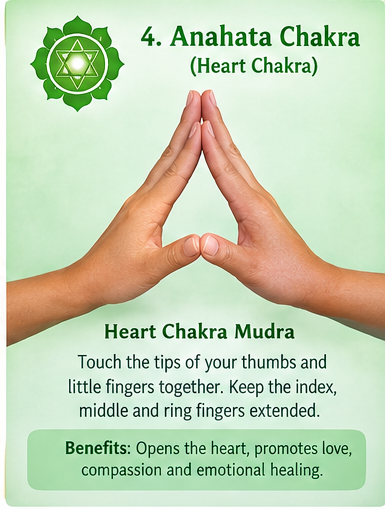
The two triangles intersect to create a yantra in the Heart Chakra sign, representing the harmony of yang and yin or both downward and upward forces. A lotus flower is outside with twelve petals, signifying the twelve holy attributes related to the heart.
Elements: Air
Colors: Green
Location: This Chakra is situated in the area of the heart, as its name suggests. The emotions of attachment, love, trust, passion, and compassion are those associated with this chakra, which is the seat of balance.
Balanced Signs: A person starts to feel more sympathetic, kind, upbeat, pleasant, and motivated when this energy center is in harmony.
Blocked Signs: When this chakra is out of balance, a person may experience emotional problems including wrath, lack of trust, jealousy, anxiety, moodiness, and fear.
Yoga Poses: Ardha Setubandhasana (Half Bridge Pose), and Matsyasana ( Fish Pose).
Beej Mantra: This Chakra’s beej (seed mantra) is ‘Yam’.
5. Vishuddha Chakra Or Throat Chakra:
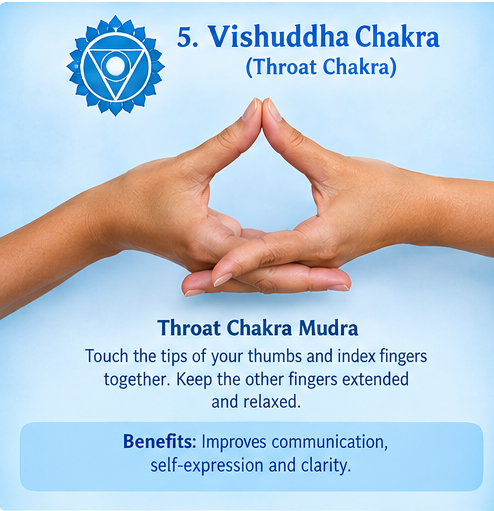
The Throat Chakra is represented by a 16-petal lotus blossom encircling an inverted triangle with a circle inside. This symbolizes the development of the spirit and the sanctification of the mind, body, and spirit.
Elements: Space
Colors: Blue
Location: The thyroid gland and the Visuddha Chakra are both found at the bottom of the throat. It is linked to creativity, positive expression, faith, and effective communication.
Balanced Signs: This chakra promotes creativity, healthy self-expression, efficient interaction, and a feeling of fulfillment when it is in balance.
Blocked Signs: The throat chakra can get blocked when we are afraid, quiet, feel weak, or find it difficult to convey our thoughts.
Yoga Poses: Sarvangasana (Shoulderstand) and Halasana (Plough Pose).
Beej Mantra: This Chakra’s beej (seed mantra) is ‘Ham’.
6. Ajna Chakra Or Third Eye Chakra:
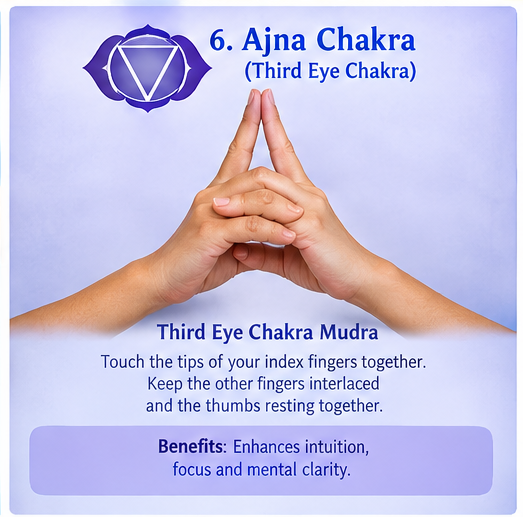
The Third Eye Chakra is represented by an inverted triangle that is perched in the middle of two lotus petals within a circle. The pyramid that faces downward and the two petals both stand for wisdom, highlighting the Third Eye Chakra’s significance in our quest for spiritual consciousness.
Elements: None
Colors: Indigo
Location: The Ajna Chakra, also known as the Agya Chakra, is situated in the space between the eyebrows. It is frequently employed as the center of attention during asana yoga to increase awareness and concentration. Practicing third eye meditation can involve gently focusing attention on the area between the eyebrows while using relaxed breathing to cultivate concentration and inner awareness. It is additionally referred to as the Third Eye Chakra.
Balanced Signs: A person feels more vivacious and self-assured when this chakra is open and in balance, both emotionally and spiritually. When one is not afraid of dying, they become their masters and are unattached to material possessions.
Blocked Signs: When out of balance, it can either make you feel narcissistic and unassailable or non-assertive and fearful of success. Physical issues like headaches, eye strain, and hazy vision might be a sign of an imbalance.
Yoga Poses: Shirshasana (Headstand).
Beej Mantra: This Chakra’s beej (seed mantra) is ‘Om’.
7. Sahastrara Chakra Or Crown Chakra:
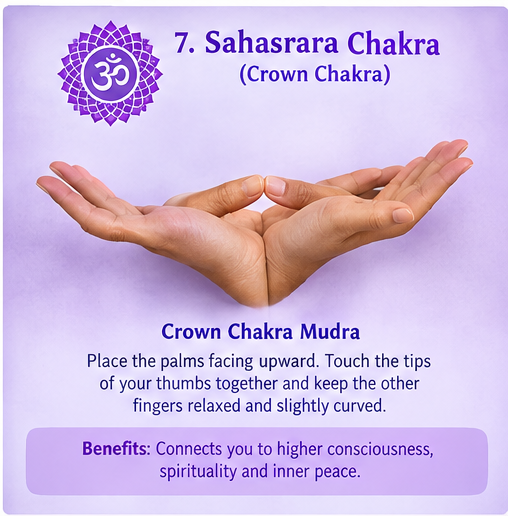
The image of the Crown Chakra is an inverted triangle surrounded by a ring of many lotus petals. The ascent of divine power into the Crown Chakra, which brings about spiritual liberty and enlightenment, is represented by this.
Elements: None
Colors: Violet, White
Location: The crown of the head is home to the Crown Chakra or Sahastrara. The heart of enlightenment, spirituality, and vibrant mind and energy is the seventh chakra. It offers the gift of universal awareness and enables the inner flow of wisdom.
Balanced Signs: Spiritual awareness, inner tranquility, and a clear comprehension of the world are all facilitated by a balanced Crown Chakra.
Blocked Signs: When it becomes out of balance, one may experience ongoing frustration, depression, and harmful emotions.
Yoga Poses: Shirshasana (Headstand).
Beej Mantra: This Chakra’s beej (seed mantra) is ‘Aum’.
Finger Elements vs Finger Chakras:
The terms “chakra fingers” and “finger elements” can refer to two related but different systems. This is why the finger-to-element list may not appear to match the chakra associations discussed later in the article.
In the five-element (Pancha Mahabhuta) system, each finger is associated with one of the five elements. In the chakra system, fingers may be associated with particular chakras or used in specific mudras. These mappings should not be treated as two versions of the same chart.
| Finger | Five-Element Association | Chakra Association |
|---|---|---|
| Thumb | Fire (Agni) | Solar Plexus Chakra (Manipura) |
| Index Finger | Air (Vayu) | Heart Chakra (Anahata) |
| Middle Finger | Space / Ether (Akasha) | Throat Chakra (Vishuddha) |
| Ring Finger | Earth (Prithvi) | Root Chakra (Muladhara) |
| Pinky Finger | Water (Jala) | Sacral Chakra (Svadhishthana) |
The element mapping explains why the ring finger is associated with Earth, while the chakra mapping connects that same finger with the Root Chakra. This is consistent with the article’s description of the Root Chakra as being associated with the Earth element.
Similarly, the pinky finger is associated with Water in the five-element system and with the Sacral Chakra in the chakra-based mapping. This explains the FAQ’s statement that the pinky represents the water element or a sacral chakra mudra.
Understanding these as two separate but complementary correspondences makes the finger and chakra information easier to follow. The same finger can therefore have an element association as well as a chakra association without the two meanings contradicting each other.
Step-by-Step Mudra Guide to Balance Your Chakras:
Below is a structured guide using Akashi Mudra, which supports upper chakra activation and energetic alignment.
Step-by-Step Instructions
Sit in Padmasana, Sukhasana, or Vajrasana
Relax your arms and calm your thoughts
Keep your spine straight
Slowly lift your head upward while inhaling
Stretch your arms gently
Touch the middle finger to the thumb
Keep the index, ring, and little fingers straight
Gaze upward and hold your breath for 15–20 seconds
Slowly lower your head
Exhale and return to a neutral position
Relax your neck and shoulders
Important: Perform the head tilt only if you do not have neck or spinal issues.
Beginner Safety Tip
Do not practice Akashi Mudra for more than 10 minutes continuously
Maintain relaxed breathing
Stop if you feel dizziness or strain
How To Avoid Common Mistakes Of Finger Mudras for Chakra Healing:
Before performing the mudras, it is recommended to warm up the hands, wrists and shoulders. Most people, especially in the West, are not used to using their hands and wrists in this way and will experience fatigue without proper preparation and practice. This is equivalent to warming up the body before any exercise. Below is an example of a warm-up.
- Rub your palms together to create heat for ten seconds.
- With your right palm facing the sky with your wrist at a 90-degree angle, pull down each finger individually and hold for ten seconds, then move on to the next finger. When all the fingers of the right hand are ready, move on to the left hand.
- With your right palm facing the ground with your wrist at a 90-degree angle, pull each straight finger down individually and hold for ten seconds, then move on to the next finger. When all the fingers of your right hand are ready, move on to your left hand.
- Extend your arms out to the sides so that they are parallel to the ground with your palms facing up, bend your wrists so that your fingertips point toward the ground, and hold for ten seconds.
- Shake your hands vigorously for ten seconds.
- Hold the backs of your hands together in front of your heart center for ten seconds.
- Once you have warmed up and have gotten the energy flowing through your body, you can begin to perform the mudra you want.
SUMMARY:
Mudras are a spiritual healing technique that dates back thousands of years and is still influential today. You may simply include these metaphorical gestures of the hand in your yoga, meditation, or chanting practice because there are distinct mudras for each of the seven chakras.
FAQs:
Q. What chakras are associated with fingers?
A. The Chakra fingers represent, therefore, each component:
The Thumb – Thumbs represent the fire elements
The Index finger – Index fingers represent the air elements
The Middle finger – Middle fingers represent the space elements
The Ring finger – The ring finger represents the earth element
The Pinky finger – Pinky fingers represent the water elements
Q. What chakra is the pinky finger?
A. The Pinky finger represents a water element or sacral chakra mudra
Q. What are the physical symptoms of a blocked chakra?
A. As soon as the Root chakra is blocked, an individual starts feeling ungrounded, unstable, fearful, lacking ambition, insecure, lacking purpose, and even frustrated.